

Monday March 2, 2026
www.thenewsdesk.ng
By Idorenyin UMOREN
Private Investigator/Security Evaluator
With agency reports
Three United States, US soldiers have been killed, and five have been seriously wounded in the ongoing conflict with Iran, the US Central Command, CENTCOM, said Sunday, March 1, 2026, announcing the first US casualties in the conflict.
The United States, US and Israel launched massive bombardments against Iran and killed its supreme leader Saturday, February 28, 2026, with the attacks continuing on Sunday.

CENTCOM did not provide further details on the circumstances of the deaths and injuries of the US service members.
“The situation is fluid, so out of respect for the families, we will withhold additional information, including the identities of our fallen warriors, until 24 hours after next of kin have been notified,” it said.
Iran has targeted American military facilities in the Middle East with ballistic missiles and drones over the past day in response to the US-Israeli bombardments. It has also fired missiles and drones at Israel, killing 10 people and injuring scores.
“Several others sustained minor shrapnel injuries and concussions and are in the process of being returned to duty,” CENTCOM said of the US casualties, adding that “major combat operations continue and our response effort is ongoing.”

However, it denied claims made by Iran’s Islamic Revolutionary Guard Corps that the American aircraft carrier USS Abraham Lincoln was struck with ballistic missiles.
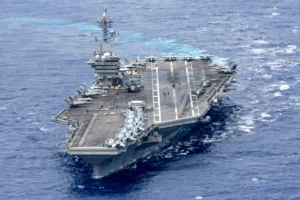
“The Lincoln was not hit. The missiles launched didn’t even come close,” CENTCOM said. “The Lincoln continues to launch aircraft in support of CENTCOM’s relentless campaign to defend the American people by eliminating threats from the Iranian regime.”
The IRGC had claimed earlier that “the US aircraft carrier Abraham Lincoln was struck by four ballistic missiles.”
Separately, CENTCOM confirmed using B-2 stealth bombers to strike underground Iranian ballistic missile facilities.
“Last night, US B-2 stealth bombers, armed with 2,000-pound bombs, struck Iran’s hardened ballistic missile facilities,” it said.
A US defense official told Fox News that four B-2 bombers flew round-trip from the US and “dropped dozens of 2,000-lb bombs on underground ballistic missile sites in Iran.”

The CENTCOM statement came after analysts monitoring open-source flight tracking data revealed that B-2 bombers had been used in recent strikes on Iran.
Last night, U.S. B-2 Spirit stealth bombers, armed with 2,000 lb. bombs, struck Iran’s hardened ballistic missile facilities. No nation should ever doubt America’s resolve. pic.twitter.com/6JpG73lHYW
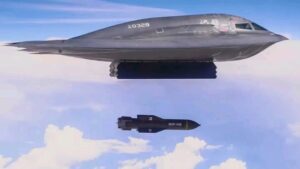
The US used B-2s, advanced aircraft known for delivering huge bunker-buster bombs, during strikes on Iranian nuclear sites at the end of the previous round of hostilities between Israel and Iran last June.
Iran continues to pound Gulf countries
Meanwhile, Saudi Arabia intercepted Iranian missiles targeting Riyadh’s international airport and the Prince Sultan Airbase, which houses US military personnel, a Gulf source briefed on the matter told AFP.
“Air defenses successfully intercepted Iranian missiles near Riyadh airport and Prince Sultan Airbase on Sunday afternoon,” the source said, requesting anonymity to discuss sensitive matters, and adding that the interception did not disrupt navigation or cause any human or material losses.

An eyewitness near the airport said they “saw and heard the air defense intercept the missile in the sky.” Residents and AFP correspondents earlier reported hearing explosions in eastern Riyadh.
Residents and AFP correspondents earlier reported hearing explosions in eastern Riyadh.
Saudi Arabia’s foreign ministry said it summoned the Iranian ambassador.
“Foreign Ministry summons the Iranian ambassador to the Kingdom in response to Iran’s brazen attacks that targeted the Kingdom and a number of brotherly countries,” the ministry said in a statement on its X account.
Since Saturday morning, Iran has launched wide-ranging strikes across the region, targeting military bases but also civilian infrastructure in the Gulf.
Dubai, Abu Dhabi, Kuwait, and Manama airports were targeted by attacks, with authorities reporting one death in the Emirati capital in the “incident” at the facility.
Saudi Arabia houses US bases and personnel, though the bigger such facilities are located in Bahrain and Qatar.
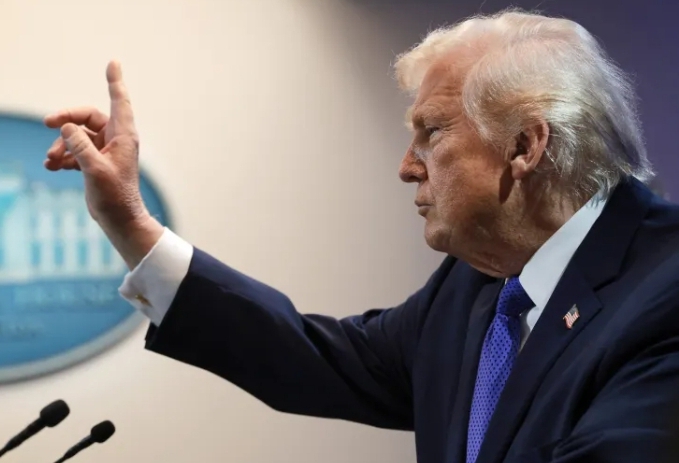
US President Donald Trump has said the goal of the military campaign is to destroy Iran’s military capacity, but has also indicated that the goal is regime change.

Prior to the escalation, Saudi Arabia had said it would not allow its territory, air, or waters to be used to strike Iran, its former arch-foe, but those assurances fell on deaf ears.
President Trump’s decision to strike Iran came after Saudi Arabia’s de facto leader privately lobbied him repeatedly to make the move, the Washington Post reported.
“Saudi Crown Prince Mohammed bin Salman made multiple private phone calls to Trump over the past month advocating a US attack, despite his public support for a diplomatic solution,” the outlet reported, citing four unnamed people familiar with the matter.
As Iran’s retaliatory strikes widened Sunday, they reverberated across Gulf Arab states, with loud blasts heard in Dubai and the Qatari capital Doha, the Bahraini capital Manama, and Oman, which was hit for the first time.
Debris from an intercepted drone damaged an Abu Dhabi complex housing the Israeli embassy and several other international missions, causing minor injuries to a woman and her child, Abu Dhabi’s state media office said.
Debris from the drone fell against the facade of the Etihad Towers complex after an interception that caused loud sounds heard across the emirate, the media office said.
Dubai’s international airport, its landmark Burj Al Arab hotel, and the man-made Palm Jumeirah Island all suffered damage overnight, as did Abu Dhabi’s international airport.
Thick black plumes of smoke continued to rise from the Jebel Ali port area of Dubai, where one of the berths caught fire Sunday because of debris from an intercepted missile.
Dubai is the biggest tourism and trade hub in the Middle East, and its airport is one of the world’s busiest travel hubs.
In Oman, the Duqm commercial port was targeted by two drones, wounding one worker, the state news agency said.
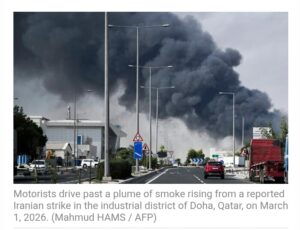
Qatar’s interior ministry said on Sunday that it was responding to a limited fire in an industrial zone, after debris fell from an intercepted missile.
As the conflict’s impact on key regional aviation and trade hubs increased, the Dutch arm of Air France‑KLM said flights to and from Dubai, Dammam, and Riyadh due to take off over the weekend were canceled.
KLM last week announced it was suspending its Amsterdam–Tel Aviv service amid fear that a war with Iran was imminent.
The carrier said it was monitoring developments closely and will update its schedule as needed, and passengers on affected flights will be rebooked once operations resume.
