

Monday January 5, 2026
www.thenewsdesk.ng
Russian-made air shields that Venezuela spent billions of dollars on failed to protect Nicolas Maduro from US forces.

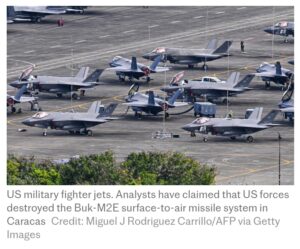
Footage taken early on Saturday in Caracas, Venezuela’s capital, showed no air defence active as US aircraft circled triumphantly in smoke-filled skies following sweeping strikes.
Some analysts have suggested that the lightning raid, which saw elite US forces descend on a highly fortified compound in Caracas to snatch its president from his bed, was made possible by cracks in Moscow’s much-vaunted air defence systems.
“Ground defence systems, especially Russian ones, suffer from a built-in disadvantage against modern air power that cannot be bridged,” Daniel Bachmat, a military analyst, said.
“They cannot withstand the combination of real-time intelligence, electronic warfare and precision weapons. In 2022, this was a minority opinion, but recent confirmations from Iran, Venezuela, and to some extent Ukraine… make this opinion more mainstream.”
Geography is also thought to have posed a challenge. Russian air defence is designed for flat terrain while Venezuela’s mountainous coastal geography can mask low-flying aircraft.
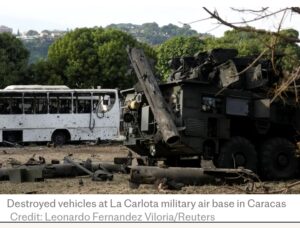
Dan Caine, the US joint chiefs of staff, told reporters on Saturday that the US had dismantled and disabled Venezuela’s air defence systems as helicopters neared Caracas in order to guarantee their safe passage to the compound.
“Those who rely on Russian weapons, air defence in particular, need to rethink in light of the past year,” Mr Bachmat said.

It was another sign of vulnerability after Israel destroyed four Russian-made S-300 air defence systems in Iran in 2024, one in April and three in a single weekend in October.
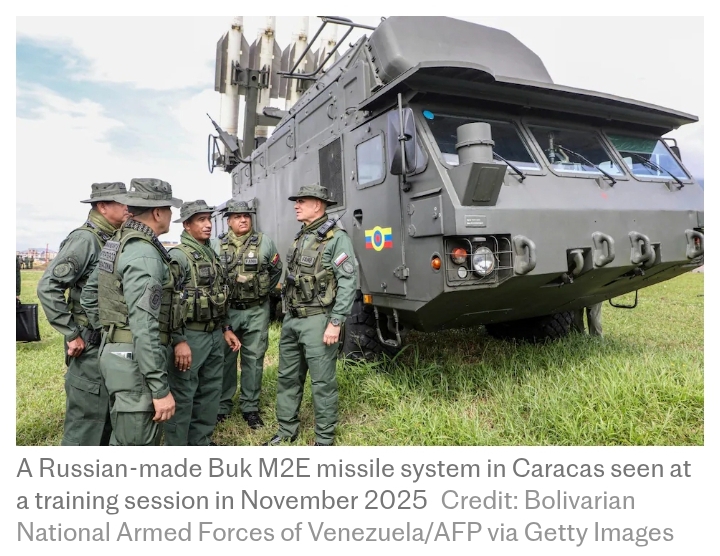
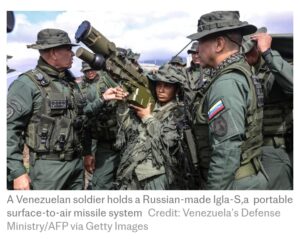
Mr Maduro had previously bragged about his Russian-designed air defence systems, which included 12 batteries of S-300VM systems, nine Buk-M2E systems, Igla-S anti-aircraft missiles and S-125 Pechora-2M units.
“Any military force in the world knows the power of the Igla-S and Venezuela has no less than 5,000,” he said in October 2025 of the Russian-made short-range low-altitude anti-aircraft missiles at his disposal.
Analysts have claimed that US forces destroyed the Buk-M2E surface-to-air missile system stationed at the La Carlota airbase in Caracas, while the S-300VM batteries never activated.
“The speed with which these systems were neutralised… signals a catastrophic failure of Russian export air defence technology against fifth-generation Western air power,” said Shanaka Anslem Perera, a geopolitical analyst.
“Every S-300 and S-400 customer, including China, India, Turkey, Iran, Algeria and Egypt, now confronts empirical evidence that Russian systems cannot defeat American fifth-generation capabilities in operational conditions,” he said, describing it as a “strategic crisis” for Moscow.
With a range of up to 200 kilometres (125 miles), the S-300 is designed to intercept both aircraft and missiles and is thought to be among the world’s most formidable systems.

“Air defence systems are Russia’s primary export for deterring American intervention,” he added.
Decades of sustained acquisition of Russian military equipment saw Venezuela’s conventional military emerge as a notch above its peers in Latin America.
This shift was spearheaded by Mr Maduro’s predecessor, Hugo Chávez, a former professional soldier who after coming to power in 1999 channelled` oil wealth into the military and relied on Russian military hardware because of an informal US embargo.
Venezuela’s military has as a result been defined by its Soviet-era weapons systems such as Su-30 fighter jets, T-72 battle tanks and S-300, Pechora and Buk anti-aircraft missiles.
In the years before 2009, Venezuela spent more than $4 (£2.9bn) billion on weapons from Russia, including 24 Sukhoi fighter jets, and received a loan that year for $2 billion (£1.48bn) to purchase 92 tanks and a S-300 missile system for taking down fighter jets.
Russia and Venezuela have been close allies for two decades, signing a strategic partnership treaty in Moscow in 2024.
On Saturday, the Russian foreign ministry called for the release of Mr Maduro and his wife from US custody and expressed “solidarity with the Venezuelan people in the face of armed aggression”.

It is understood that Mr Maduro reached out to Vladimir Putin to plead for assistance in October as the US increased military pressure, asking Moscow for help overhauling eight engines and five radars in Russia and acquiring 14 sets of what were thought to be Russian missiles.
He also asked for help restoring several Russian Sukhoi Su-30MK2 aircraft already in Venezuela’s possession, The Washington Post reported.
Alexei Zhuravlyov, the deputy chairman of Russia’s parliamentary defence committee, later said that Russia would consider providing its most advanced hypersonic missiles to Venezuela, warning: “The Americans may be in for some surprises.”
Instead, the US may consider the episode confirmation that Russia is little more than a “paper tiger”.
(Telegraph.co.uk)
