
Tuesday December 23, 2025
www.thenewsdesk.ng
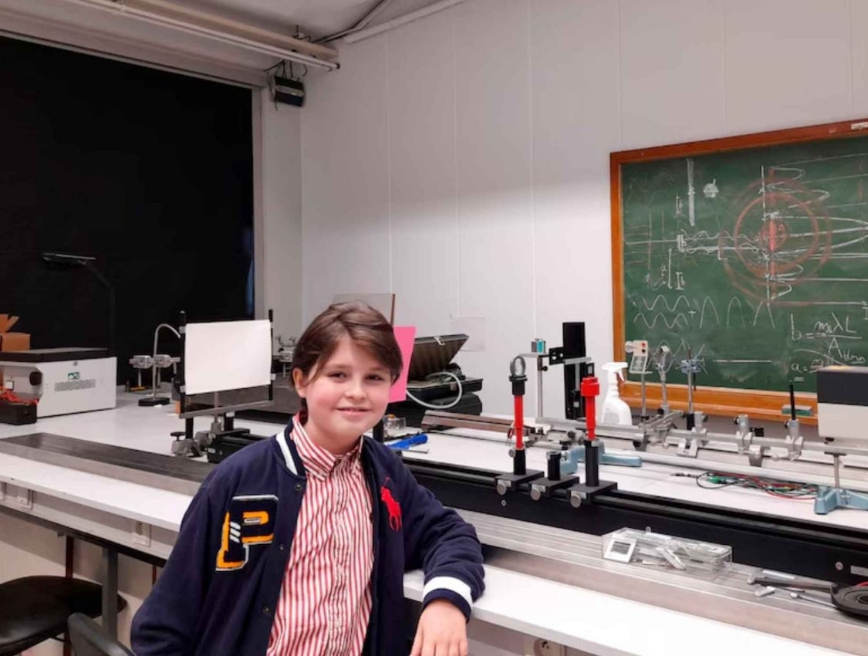
At 15 years old, Belgian researcher Laurent Simons earned a PhD in quantum physics from the University of Antwerp. He says the degree is a means to a larger goal: building longer, healthier lives by enhancing human biology.
Simons research focuses on Bose polarons, mobile impurities dressed by surrounding particles, in superfluids and supersolids.

University records include a listing that confirms his public defense and thesis title on November 17, 2025.
Belgian media claims he is the youngest doctoral recipient in the country, and his earlier milestones arrived unusually fast.
He finished high school at eight and completed a three-year bachelor program in just eighteen months.

Comparisons across nations can get tricky because degree structures differ, and program lengths vary widely across departments.
Still, the Antwerp timeline is clear enough to stand without qualifiers or marketing language layered on top.
Laurent Simons And His Thesis:
His coauthored preprint examines how an impurity behaves inside a one-dimensional dipolar supersolid.
A supersolid, a state showing crystal order and superfluid flow, supports unusual excitations compared with ordinary quantum fluids.
Those properties are not just theory, as careful experiments have observed long-lived supersolid behavior in dipolar quantum gases.
A Bose-Einstein condensate (BEC), atoms cooled so cold they act as one, provides the tunable stage for these studies.
The analysis relies on a variational approach that balances accuracy with tractable math for complex many-body problems.

That method has helped physicists calculate properties in related systems where exact solutions remain out of reach.
The project also sketches how light absorption could read out a supersolid impurity’s motion, revealing multiple peaks tied to distinct modes.
Those features would give experimenters new knobs to test theory with careful measurements in ultracold setups.
Medicine And Health Over Tech:
“After this, I’ll start working towards my goal: creating ‘super-humans’,” said Simons. His parents have also turned down early offers from United States and China-based technology firms, prioritizing medicine over hype.
Before the doctorate, he was highlighted in a Max Planck feature that introduced his internship in Munich labs.
There he encountered quantum optics, the study of light interacting with matter, and began thinking about medical applications.
Turning down high profile roles protects focus, especially when unsupervised lab access would muddy both ethics and education.

Oversight matters more than headlines, because youthful curiosity still needs experienced hands around dangerous equipment.
If companies come calling later, he can weigh them against clear goals and a stronger scientific base.
Right now, building depth is likely the smarter move for durable contributions rather than quick novelty.
Understanding His Thesis:
The thesis models how a single extra particle deforms a sea of bosons, changing energy, size, and motion.
A boson, a particle that likes to share quantum states, behaves collectively at ultracold temperatures.
Understanding that dressed particle helps researchers test how new phases respond, which eventually guides sensing and materials ideas.
It is foundational work, yet it connects to real tools like precision spectroscopy and ultracold probes of complex behavior.
Medical Science And AI:
Right after the defense, he returned to Munich to start a second doctorate in medical science with artificial intelligence.
Here, artificial intelligence, software that learns from data patterns, helps sort biological signals for potential diagnostics.
Extending life expectancy demands rigorous clinical evidence, careful safety checks, and incremental steps, not promises that outrun biology.
So his plan will likely pass through measurable milestones, from better screening algorithms to smarter drug testing pipelines.
Medical models can overfit, so external validation, clean datasets, and bias checks will make or break outcomes.
He will need collaborators in clinical science who can frame questions and translate signals into proven care.
Training in precise measurement, uncertainty, and modeling gives a sturdy toolkit for tackling noisy biological data. That is where physics habits, like calibration and controls, really start pulling their weight well.
Media Buzz Around Laurent Simons:
Records around the youngest doctorate are messy, since there is no single authority that tracks ages across fields.
What does stand up cleanly are the university listings and the research trail created through publications.
Treat viral headlines as snapshots, then look for the source materials that actually document the work.
Simons currently has those, including an official defense schedule and technical manuscripts that explain his models.
When very young scientists speak loudly, people often project fantasies onto their words and skip the fine print.
Here, his stated aim is extending healthy lifespan, which is a tougher, narrower goal than mythical immortality.
The pace may feel extreme, yet the milestones line up with documented work and sensible next steps.
Watching the methods and publications, rather than the hype cycles, will give the truest signals here.
Laurent Simons Wants To Help:
Progress in this area depends on teams, mentors, careful experiments, and theory that holds up under replication.
The Antwerp work links directly with groups in Munich and elsewhere that run advanced ultracold platforms.
His longevity ambition also brings important questions about equity, consent, accessibility, and who benefits first from enhancements.
Real progress will depend on transparent guardrails, tested therapies, and a diverse set of voices steering development.
Look for partnerships across Antwerp, Munich, and other hubs that build and test ideas with complementary strengths.
That network effect tends to convert individual promise into durable, shareable progress across labs and disciplines.
Meanwhile, ultracold experiments keep refining the supersolid picture, offering precise benchmarks for the theoretical models he is pursuing.
Theory will catch up fastest when those measurements pin down where the models hold and where they break.
*The study was published in Physical Review X.
