
Wednesday December 17, 2025
www.thenewsdesk.ng
By Dr Gerald Onyebuchi Onukwugha.
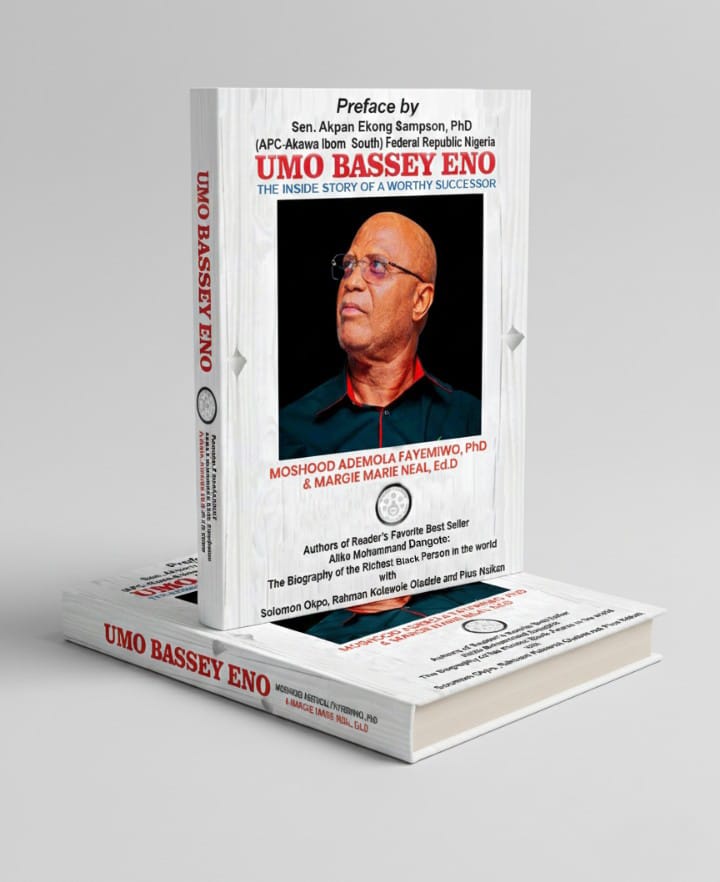
The advanced copy of the book: Umo Bassey Emo; the Inside Story of a Worthy Successor written by Dr Moshood Ademola Fayemiwo and Dr Margie Marie Neal is a captivating piece. In this exhilarating biography, the authors,, with a preface by
Senator Akpan Ekong Sampson, PhD, and First Words by former Governor Udom Gabriel Emmanuel, sketches out and X-rays the life of the people’s governor, Umo Bassey Eno, whose leadership style is transformational.


This informational-packed work is a masterpiece in essay flair with a writing style that is readable and accessible. This biography is not merely an account of a life; it is a meditation on how place, memory, and moral ecology conspire to form a human being. At its core, it advances a quiet but profound thesis, namely: that leadership is less the product of sudden brilliance than of slow social sedimentation, the layering of values, disciplines, and narratives deposited over time by family, faith, and community. Ikot Ekpene Udo, the ancestral village of Governor Umo Bassey Eno as the authors pointed out, emerges in this narrative as more than a village. It is rendered as a moral geography, a landscape in which ethics are spatially embedded, and social life is governed by an unspoken covenant of trust. The proverb “Owo isioho inuen ke ekpat itagha” is not ornamental folklore; it functions as an ontological and metaphysical claim about how human beings ought to inhabit shared space. In such a world, reputation substitutes for surveillance, and character precedes credentials. Poverty is redefined not as lack of material abundance but as the absence of faith, kinship, and moral standing; a definition that subtly subverts modern economic metrics of value.
The biography’s philosophical depth lies partly in its treatment of absence. Ikot Ekpene Udo is an “absent presence” in Governor Umo Bassey Eno’s childhood, a homeland not lived in continuously but invoked persistently. This tension complicates simplistic narratives of origin. Identity here is not forged solely by physical immersion but by repeated narration. The village exists as a symbolic anchor, sustained through memory, return visits, and familial storytelling. In this sense, the text affirms and validates a classical insight: that belonging is as much remembered as it is inhabited. Equally instructive is the duality of Enugu and Ikot Ekpene Udo.


From his ancestral village of Ikot Ekpene Udo, the authors took the reader to the Coal City of Enugu where Governor Umo Bassey Umo was born, albeit in questionable birth dates; 1961 or 1964. In the biography, the authors narrated how the parents of young Umo met and consummated their marriage and were soon shipped to Enugu because of national assignments of the elder Eno as Chief Superintendent of Police in the 1960s.
While Enugu represents the modern state, characterized by bureaucracy, industry, discipline, and hierarchy, Ikot Ekpene Udo represents the pre-modern moral order: kinship, oral tradition, and communal accountability. The subject of the biography is shaped at the intersection of these worlds. The police barracks life in Enugu instills punctuality and rule-governed conduct; the village bequeaths an ethic of stewardship and mutual obligation. This biography thus resists the false dichotomy between tradition and modernity, showing instead how productive leadership often arises from their synthesis. It encapsulates in its rudimentary form the Hegelian dialectic in its analysis of Governor Umo’s leadership style later when he grew up Lagos and as a business man, an entrepreneur and later as a commissioner in Akwa Ibom State.


Religion, particularly Christianity as mediated through the Qua Iboe tradition, is portrayed neither as mere dogma nor as colonial residue, but as a moral technology, a framework for meaning-making, discipline, and hope in contexts of material scarcity. The concept of a “quiet spirituality” is especially evocative. Faith here is not performative; it is habitual, embedded in daily rhythms, family altars, and communal worship.
The Christian Religion to be exact is devoid of compartmentalization. It is a continuum. The church operates as a school of conscience, translating biblical narratives into lived ethical expectations. The description of Ikot Ekpene Udo as “Little Bethlehem” is thus less triumphalism than symbolic: it signals a place where significance is not proportional to size or power. The biography also handles difference and misperception with philosophical sensitivity. The authors go deeper in the persona; the look of the governor. Is he an albino as being asserted? The discussion of complexion and the mistaken attribution of albinism gestures toward a broader
meditation on the manners and ways societal interpretation of bodily difference, evidently from the place of both crass and affected ignorance. What appears as a minor biographical detail becomes a lens for examining stigma, the problem of Othering, and the social construction of normalcy? The text suggests, without overstatement, that early experiences of being misread can cultivate empathy, introspection, and an acute awareness of marginality. Parental influence is rendered as formative without lapsing into determinism. The father embodies institutional authority and order; the mother models industrious faith and intellectual aspiration. Together, they transmit a coherent moral grammar: discipline without cruelty, ambition without arrogance, faith without escapism. Education, in this framework, is not merely instrumental but redemptive, a means of dignifying life under constrained circumstances. The biography thus affirms an ancient philosophical insight: that character is often formed at the dinner table long before it is tested in public office and a platform of authority/power. Perhaps most striking is the biography’s insistence that leadership is inseparable from moral memory. Governor Eno’s eventual rise from barracks boy to governor is not narrated as a rupture from the past but as its fulfillment. Success is framed as an obligation rather than an entitlement.


The recurring theme in this work is what the authors want readers to know that “one’s success must elevate others” echoes classical virtue ethics, where excellence (aretē) finds its meaning in service to the common good. On a special note, it could fundamentally be asserted that this biography functions as a moral parable disguised as history. It reminds the reader that human flourishing is rarely accidental; it is cultivated in ordinary places, through repeated acts of care, discipline, and belief. It invites a rethinking of leadership not as spectacle but as stewardship, not as self-assertion but as responsibility.
In an age enamored with speed and visibility, the life sketched here testifies to the enduring power of slow formation, communal ethics, and faithful perseverance. If there is a single philosophical lesson to be drawn, it is this: who we become is inseparable from the worlds that formed us, even, and perhaps especially, the world’s we did not fully inhabit but were taught to remember. Overall, this scintillating biography succeeds not only as a literary portrait of the Akwa Ibom State governor, but a profound reflection on the moral architecture of leadership. By tracing the slow, deliberate formation of character through family, faith, community, and memory, the authors supported by field officer and research assistants; Messrs. Solomon Okpo, Rahman Kolawole Oladele and Pius Nsikan, remind readers that transformational leadership is rarely accidental or abrupt. It is patiently cultivated at the intersection of tradition and modernity, discipline and compassion, remembrance and responsibility. The life narrated in these pages affirms that authentic leadership flows from moral grounding and communal accountability, where success is measured not by personal ascent but by collective uplift. Ultimately, this biography of His Excellency, Governor Umo, challenges contemporary notions of power and achievement, offering instead a timeless vision of leadership rooted in stewardship, ethical memory, and service to the common good. It is a vade mecum.
*Dr. Gerry Onukwugha, author of “The Million-Dollar Speaker: Building A Million Dollar Speaking Career” is a National Security and Policy Expert based in New Jersey, United States of America.