

Monday December 1, 2025
www.thenewsdesk.ng
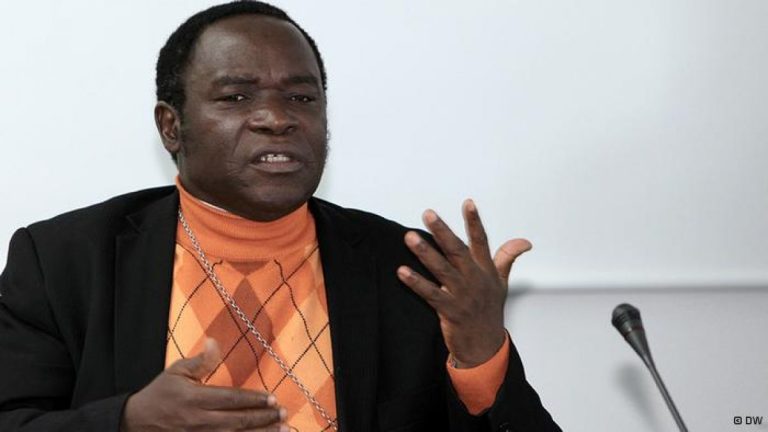
The Catholic Bishop of the Sokoto Diocese and Convener of the National Peace Committee (NPC), Most Rev. Matthew Kukah, has pushed back against narratives suggesting that Christians in Nigeria are victims of genocide, maintaining that such claims misrepresent both his work and the realities on the ground, SAHARA REPORTERS reported.
Speaking in Kaduna while delivering a paper at the 46th Supreme Convention of the Knights of St. Mulumba (KSM), Kukah said his position has often been distorted. He clarified that his extensive research, presented previously at the Vatican, does not support assertions that genocide or martyrdom is occurring in Nigeria.

“People say there is genocide in Nigeria. What I presented at the Vatican was a 1,270-page study on genocide in Nigeria and elsewhere. My argument is that it is not accurate to claim there is genocide or martyrdom in Nigeria,” he said.
Kukah cautioned against loosely applying the term “martyrdom,” questioning assumptions made whenever violence targets a place of worship. “Because someone is killed in a church, does that automatically make them a martyr? Whether you are killed while stealing someone’s yam or attacked by bandits, does that qualify as martyrdom? I am worried because we must think more deeply.”
Aligning with positions taken by the Vatican Secretary of State and the leadership of the Catholic Bishops’ Conference of Nigeria, Kukah emphasized that the Catholic hierarchy does not believe Christians are being systematically persecuted in the country.

He also dismissed figures being circulated about church attacks.“They are saying that 1,200 churches are burnt in Nigeria every year, and I ask myself, in which Nigeria? Interestingly, nobody approached the Catholic Church to get accurate data,” he noted.
“We do not know where these figures came from. All those talking about persecution; has anyone ever called to ask, ‘Bishop Kukah, what is the situation?’ The data being circulated cleverly avoids the Catholic Church because they know Catholics do not indulge in hearsay.”
Explaining what constitutes genocide, Kukah stressed that the defining factor is intention.“Genocide is not based on the number of people killed. You can kill 10 million people and it still won’t amount to genocide. The critical determinant is intent; whether the aim is to eliminate a group of people. So, you don’t determine genocide by numbers; you determine it by intention. We need to be more clinical in the issues we discuss.”

He further challenged claims that Christians in Nigeria are systematically targeted.“If you are a Christian in Nigeria and you say you are persecuted, my question is: how? At least 80% of educated Nigerians are Christians, and up to 85% of the Nigerian economy is controlled by Christians. With such figures, how can anyone say Christians are being persecuted?”
Kukah argued that unity among Christians would help eliminate discrimination.“The main problem is that Christians succumb to bullies. The day we decide to stand together, believing that an injury to one is an injury to all, these things will stop.”
In October, Kukah appealed to the United States not to return Nigeria to the list of “Countries of Particular Concern” (CPC), warning that such a move could inflame tensions and give criminals more room to exploit religious divides. He said collaboration, not punishment, would better support efforts by religious leaders and the government to strengthen dialogue under President Bola Tinubu’s administration. He acknowledged ongoing violence but maintained that it does not amount to total religious persecution.
Despite this, in November, U.S. President Donald Trump officially redesignated Nigeria as a “Country of Particular Concern” over severe violations of religious freedom. This marks the second time the Trump administration has given Nigeria the label, the first being in December 2020. The designation was removed in 2021 by the Biden administration.
